

Let's take a journey through H.4145, the SC Pray Safe Act.
What a name. Pray Safe. It's almost perfect marketing, instantly pulling at the heart of South Carolinians. After all, South Carolina is considered a central part of the Bible Belt. A bill with pray in the title sounds comforting, moral, even necessary.
But once you step into the actual words of the bill, one can't help but ask… What does this have to do with praying?
A Quick Note on Version Awareness
Before we dig in, note that the version introduced on March 5, 2025, is not the same bill that came out of the Judiciary Committee on February 3, 2026.
This walkthrough covers the amended committee version, the one the House will discuss on the House floor soon.
Always check which version you're reading. (This is one of those things we teach in the SC Bill Reading Boot Camp, which we hope to offer soon.)
Moving on to the Summary
TO AMEND THE SOUTH CAROLINA CODE OF LAWS BY ENACTING THE "SOUTH CAROLINA PRAY SAFE ACT" BY ADDING SECTION 23-3-90 SO AS TO ESTABLISH THE SOUTH CAROLINA PRAY SAFE GRANT PROGRAM WITHIN THE SOUTH CAROLINA LAW ENFORCEMENT DIVISION TO PROVIDE GRANTS FOR SECURITY ENHANCEMENTS TO CERTAIN ORGANIZATIONS THAT ARE AT RISK OF BEING VICTIMS OF A RELIGIOUSLY MOTIVATED CRIME.
That's a lot of words, and still nothing about praying.
H. 4145 proposes to add a new law (growing government power) and create a grant program (taxpayer money).
What is the grant for?
Security enhancements for certain organizations (what does "certain" mean?) that are at risk of being victims of a religiously motivated crime.
Pause. Religiously motivated crime? That’s incredibly broad and subjective. Many acts could be framed that way, depending on who is defining motive.
Still, no praying.
The Definitions Part Are Where You Should Slow Down
Whenever you hit a definitions section, slow down. This is where words stop meaning what everyday people think they mean and start meaning whatever regulators later decide they mean.
Remember that phrase from the summary, grants for certain organizations? Here’s how the amended bill defines who qualifies:
Section 23-3-90. (A)(1) "Eligible applicant" means a private religious organization that is: (a) qualified for federal tax-exempt status under section 501(c)(3) of the Internal Revenue Code; (b) at risk of being subject to a religiously motivated crime; and (c) is a religious organization as defined in Section 1-33-10.
What does SC Code Section 1-33-10 say?
It defines religious organization to include, but is not limited to, houses of worship, religious ministries, organizations, social agencies, groups, corporations, educational institutions and other entities whose principal purpose is the study, practice, or advancement of religion.
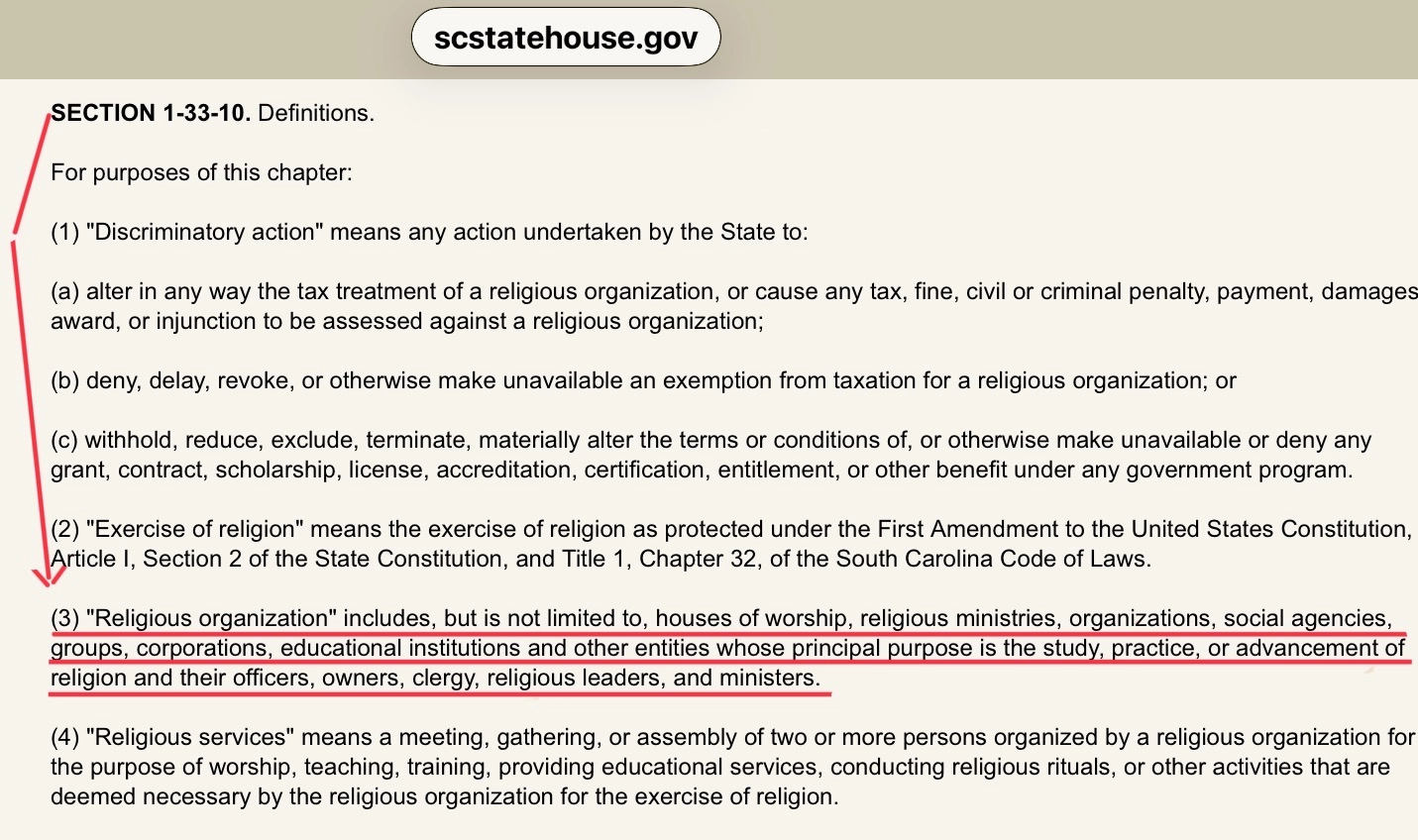
That phrase includes, but is not limited to is doing a lot of heavy lifting. So basically, any organization that structures itself as a religious nonprofit and claims risk can potentially qualify for the pray safe grant.
There is no firm, limiting definition of what counts as religious.
Could a fringe organization calling itself a church — say, the destroy America church — qualify?
Still waiting for the praying part.
"Religiously Motivated Crime" Defined, Sort Of
Section 23-3-90 (4): The bill defines religiously motivated crime as:
“the commission, attempted commission, or alleged commission of an offense against a religious organization based on the religious ideology or mission of the organization or the population served by the organization.”
That definition leaves a lot of room for interpretation. Who decides what constitutes religious ideology? Who determines motive? And what qualifies as an allegation? Does a police report count? A phone call to SCDPS? A social media post? The bill doesn't say. Combined with the undefined terms around religious ideology and motive, SC Department of Public Safety (SCDPS) ends up with wide latitude to decide which allegations are credible and which aren't.
The original bill placed the grant program inside SLED (the South Carolina Law Enforcement Division). The amended version moves it to the SCDPS.
Why is the legislature handing an agency built for traffic enforcement the authority to assess religious threat levels and decide which houses of worship deserve taxpayer funding instead of asking whether this program needs to exist at all?
The original bill allowed individual grants up to $750,000. The amended version caps individual grants at $5,000, with a total fund cap of $750,000 per fiscal year. At least they lowered per applicant, and gosh, what were they thinking with $750K per applicant? It's hard to imagine what level of security enhancement would require three-quarters of a million dollars for one organization.
The committee amendment expanded (3) "Offense against a religious organization" includes an offense against: (a) an employee or agent of the organization; (b) the eligible facility itself; or (c) individuals frequenting the eligible facility as part of the population served by the organization.
That third one is a significant expansion. Now a threat or incident involving someone who simply attends or visits the facility counts as an offense against the organization.
So think about what that means practically. An organization doesn’t need to show that it was targeted or that its staff was targeted. Someone getting into an altercation in the parking lot with a congregant could potentially be characterized as an offense against a religious organization under this language, which strengthens the case for grant funding.
It also raises the question of what frequenting means. Is that a regular attendee? Someone who showed up once? A person using a food bank operated out of the facility? The bill doesn’t define it.
Another one for the sinkhole file.
The amended version includes any other security enhancement consistent with the purpose of the South Carolina Pray Safe Grant Program. That's an open-ended category that gives SCDPS broad discretion to approve nearly anything under the umbrella of "security."
The Centralized Power and Growing Cost Problem
SCDPS would control rulemaking, application standards, risk assessment, grant approvals, and oversight and enforcement.
And the fiscal impact statement reveals that the bill creates a separate fund in the State Treasury for the grant program, but it doesn't identify how the fund will be funded.
Fiscal: It is unclear how the Fund will be funded.
So, how will taxpayers be responsible for paying for this?
Why Do We Need This At All?
South Carolina already has laws against vandalism, assault, arson, harassment, and acts of terrorism. And we have police officers whose job it is to protect people from these very things.
So why do we need a new taxpayer-funded grant program, administered by a new bureaucratic process, with undefined funding, layered on top of it?
And One Last Thing...
Despite the title, the word "pray" never appears in the bill.
And not all religious organizations pray.
This makes the title symbolic of the problem itself. A name designed to create instant support of H.4145 without reading what it is actually proposing and the unintended consequences.
Call to Action
This bill is on the House calendar, waiting to receive 2nd reading, with fifteen requests for debate already filed. Contact your Representative and tell them to vote No.
Disclaimer: The views expressed in this article are those of the author and do not constitute legal or professional advice. ConservaTruth assumes no liability for any actions taken based on this content. Readers are encouraged to review the bill text themselves. Read more.

Subscribe to ConservaTruth's Email Newsletter for curated insights on South Carolina's legislative activities and conservative viewpoints, delivered straight to your inbox! With vetted and easy-to-understand information, our newsletter empowers you to become an informed and engaged citizen, actively participating in safeguarding our cherished Constitutional values. Don’t miss out on crucial updates—join our community of informed conservatives today!

Comments