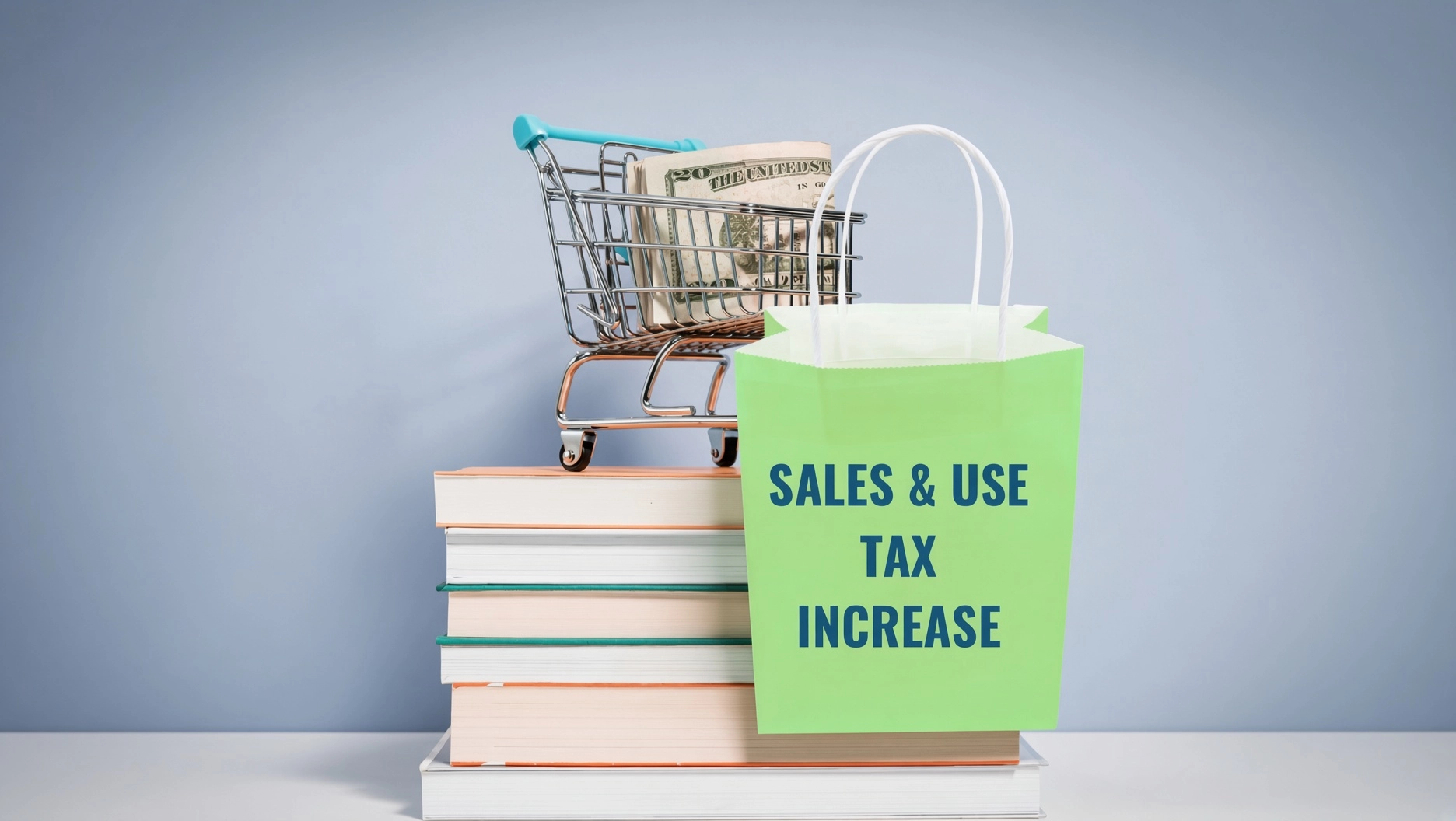

Did you know? In November, Dorchester County voters will decide whether to approve a 1% Education Capital Improvements Sales and Use Tax for the next 15 years.
On top of already rising costs for gas, groceries, insurance, utilities, and just about everything else, Dorchester County residents would see the general sales tax increase from 7% to 8% on most taxable purchases if this passes.
So, how did we get here?
And that takes us to bill H.4589.
The Bill that made this possible.
H.4589 was filed on 12/16/25, and this is what it started with.
TO AMEND THE SOUTH CAROLINA CODE OF LAWS BY AMENDING SECTION 4-10-470, RELATING TO COUNTIES IN WHICH THE EDUCATION CAPITAL IMPROVEMENTS SALES AND USE TAX MAY BE IMPOSED, SO AS TO PROVIDE ADDITIONAL AUTHORIZATIONS.
Be it enacted by the General Assembly of the State of South Carolina: SECTION 1. Section 4-10-470 of the S.C. Code is amended by adding:
(G)(1) The Education Capital Improvements Sales and Use Tax authorized by this article also may be imposed in a county which does not meet the collection requirements of subsection (A) so long as the county is only imposing the local option sales tax imposed pursuant to Article 1, and the county has only imposed that tax for less than ten years as of the date of the imposition of the education capital improvements sales tax authorized in this article and:
(a) the county in which the tax is to be imposed is encompassed completely by one entire school district; and
(b) the county collected less than fifty thousand dollars in state accommodations taxes as imposed pursuant to Section 12-36-920(A) in the most recent fiscal year for which full collection figures are available.
(2) Once a county meets this threshold, it thereafter remains eligible to impose this tax pursuant to this subsection.
SECTION 2. This act takes effect upon approval by the Governor
See that? The bill was short. As filed, it simply created another exception allowing certain counties that did not already qualify under section 4-10-470(A) to impose the Education Capital Improvements Sales and Use Tax.
Side note: H.4589 is a perfect example of never supporting a bill simply because you like the language as filed.
Now let’s go to the amended bill that ultimately passed into law. As it moved through the legislature, three important things happened.
One: The original bill addressed a county encompassed by one school district. The amended bill added a separate pathway for a county encompassed by two school districts. There you go. Dorchester County was now in the game.
Two: The April 29 version required the resolution to be agreed to by a majority vote of the board of trustees of each school district in the county. For Dorchester County, that meant DD2 and DD4. Then, on May 12, Senator Sean Bennett amended that language and gave the power to adopt the approving resolution to County Council instead. Senator Bennett's reason was that Dorchester County has two school districts and that the districts could produce different referendum language. His solution was to remove the school boards from the required approval and give that power to County Council.
Translation: he shifted the decision-making power to County Council, likely because it would be easier to pass the resolution through County Council than going through the school board and then County Council.
A “resolution” in this context is the formal action that triggers whether the referendum even gets placed on the ballot. It is not the final vote on the tax itself, but it is the gatekeeping step that determines whether the question ever reaches the ballot in the first place.
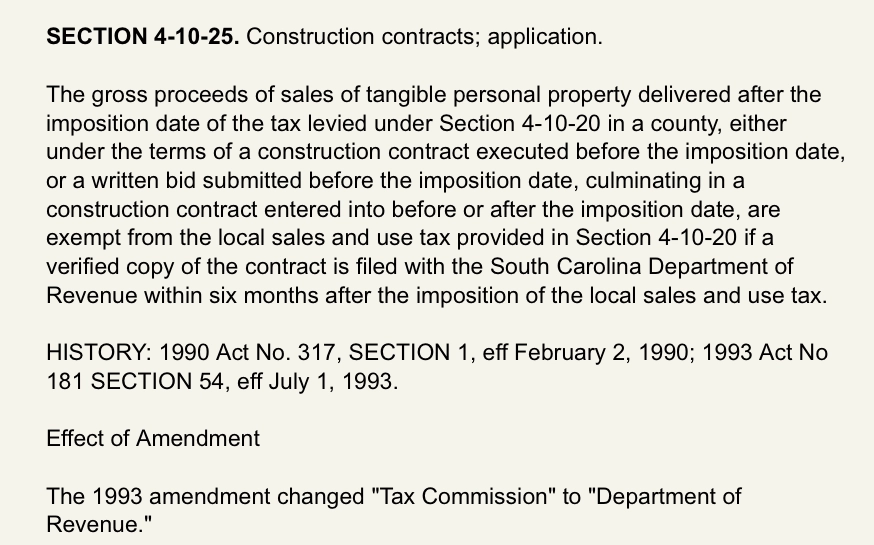
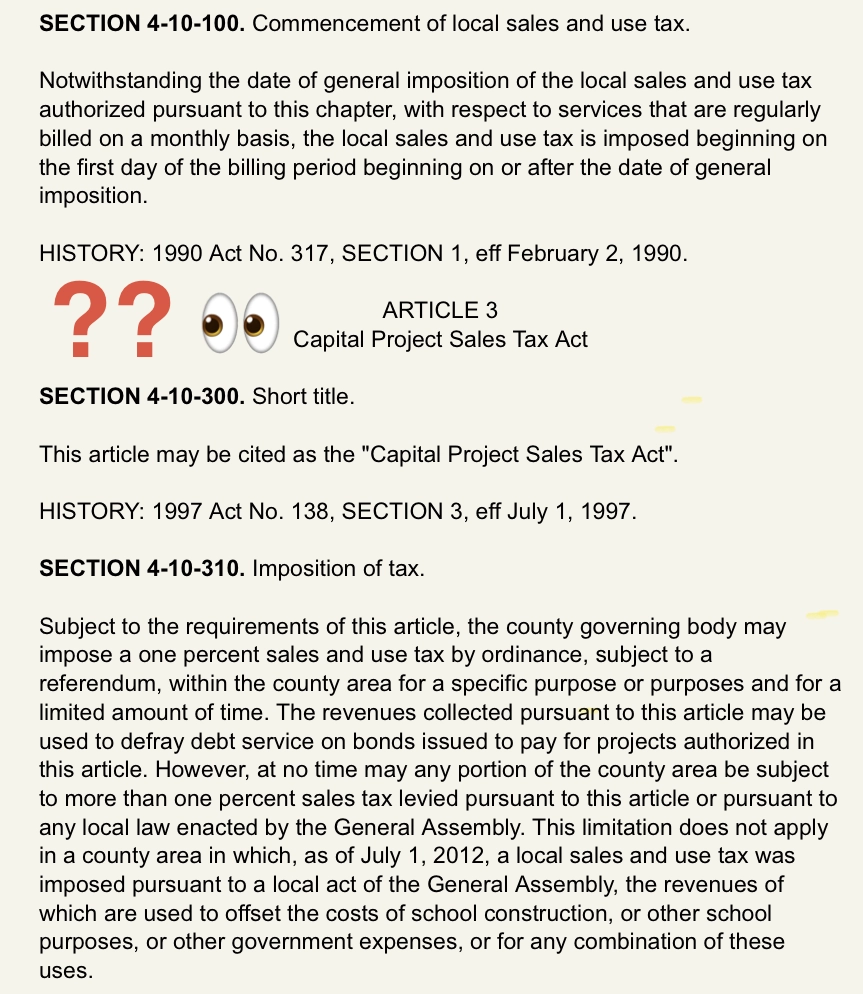
Three: The amendment adds some mistakes. Mistake one: The enacted language references section 4-10-125, which we could not find in the current South Carolina Code. Mistake two: The law references section 4-10-25 for an approving resolution, but section 4-10-25 deals with construction contracts, not approving resolutions. The approving-resolution provision is section 4-10-425.
How many legislators actually read the final bill before voting for it? Take a guess.
The Predictable Reason for Passing the Bill
Legislator, why did you vote for a bill that opens the door to another tax increase? Here’s one response: “This is happening because both DD2/4 asked for the law to be changed to give them the option. The vote for is not agreeing with raising taxes; it’s to give the districts the opportunity to present said option to the voters.”
Come on now, when legislators vote to open the door to a tax increase, there is a pretty good chance one will follow.
Here is another little gift buried in the bill that passed into law. Once a county qualifies and actually imposes the tax, the law says it “thereafter remains eligible” to impose the tax under this subsection. In other words, this pathway doesn’t disappear when this 15-year tax ends. If the tax is imposed, the county remains eligible to pursue it again.
“(4) Once a county meets the provisions of item (1) and imposes the Education Capital Improvements Sales and Use Tax, it thereafter remains eligible to impose this tax pursuant to this subsection.”
And There Are More Red Flags
The fiscal impact statement identified only two counties that met the new eligibility requirements: Union and Dorchester.
Why is the General Assembly tailoring statewide tax law in a way that creates a pathway for Dorchester County? If Dorchester County has a local problem requiring a local solution, why are state legislators creating the mechanism?
Where were the constituents?
We found the legislative meetings, amendments, votes, Bennett’s floor explanation, and we know school and county officials were involved in discussions. What we have not found is evidence of Dorchester legislators broadly going to the constituents who would eventually pay this tax and asking: "We are considering changing state law so Dorchester County can pursue another 1% sales tax for 15 years." Here is what the bill does. What do you think?
If those meetings happened, show us. If they didn’t happen, why not?
The Predictable Pattern
Some legislators and a County Council member claimed their vote was simply to allow the people to decide whether they want another tax increase.
Who could object to letting the people decide? Except people don’t wake up one morning and demand another tax. So will the people actually decide, or will the predictable pattern help ensure the tax increase becomes reality?
What’s that pattern?
First, legislators pass a bill that creates a tax-increase option. Then DD2 and DD4 officials present the need, and County Council members unanimously vote to put the referendum on the November ballot. Then comes the marketing campaign, which has already started. There are already Facebook posts advocating passage, including one County Council candidate urging voters to vote yes because children should not “pay the price” for past decisions and because the government needs to plan better for growth.
And there it is: the noble cause. It’s for the children. Overcrowded schools, aging buildings, accommodating growth. Nobody wants children sitting in overcrowded classrooms or schools falling apart.
Now consider who will vote YES for this come November: mostly uninformed voters who will see Facebook posts and comments about overcrowded schools and children, or voters who walk into the booth knowing almost nothing about what they are voting for. Then there are employees, families, and others directly connected to DD2 and DD4 who have an institutional or personal interest in seeing more money go to the districts.
The predictable pattern is complete. Sales tax goes up.
The politicians who supported this will defend their stance by stating, “The people decided.” That right there is how they get away with participating in this tax increase.
What Exactly Are We Paying For?
Now let’s look at the problem this sales tax increase is supposed to fix.
DD2 estimates $400–600 million in deferred maintenance and repairs and another $150–200 million in near-term growth-related capital needs. DD4 also lists substantial capital projects, but its resolution does not attach an overall dollar amount to those needs.
Deferred maintenance means the district put off needed repairs. Growth-related costs are for adding space and capacity as the population and enrollment grow.
We reviewed the DD2 and DD4 resolutions. Both districts list the capital projects they want to fund with the tax revenue.
DD2 lists new construction, expansions, renovations, roofs, HVAC systems, buses, playgrounds, flooring, lighting, furniture, technology, fine arts, athletic facilities, and CTE programs. DD4 lists new schools, additions, renovations, athletic facilities, temporary classrooms, facility upgrades, capital maintenance, and technology.
Neither resolution tells taxpayers what each project will cost.
Link to DD4 and DD2 resolutions.
Remember, DD2 voters already approved $200 million in bonds in 2024. During his July 20 presentation to County Council, Superintendent Chad Daugherty also stated that DD2 receives approximately $24–25 million annually in “8 percent” capital funds.
Now, two years after that approval, officials are discussing millions more in capital needs.
Btw, this new sales tax revenue will not arrive as a lump sum and will be collected over 15 years, which doesn’t instantly fund the fix that needs an immediate fix. DD2 officials have already acknowledged that this tax will not cover all of the district’s claimed capital needs.
The exact language from the DD2 resolution is:
“the Board recognizes that proceeds from the Sales Tax will not, in isolation, address all its known education capital needs, and that additional sources of revenue will be required”
So What Is the Root Problem?
How did deferred maintenance reach millions? If roofs, HVAC systems, flooring, lighting, and other assets have accumulated that level of backlog, something over time created it.
If it is driven by residential growth, then we have another issue. The DD2 Board has previously asked County Council to consider impact fees and other growth-related funding tools so development helps pay for the infrastructure it creates. Is that a better solution? Impact fees don’t solve deferred maintenance, but can they reduce how much existing taxpayers are to absorb the expense for growth-related capacity?
By the way, the resolutions themselves show that this tax is not simply about deferred maintenance. Are taxpayers getting the whole picture?
It’s also interesting that Council approves growth that contributes to overcrowded schools, then turns around and places a countywide tax referendum on the ballot to address the resulting strain.
When a private company repeatedly asks investors for hundreds of millions more, investors demand answers about prior spending and performance. Taxpayers should expect the same level of accountability.
Disclaimer: ConservaTruth is fully aware that government-mandated impact fees are still government-imposed costs. Maybe the better answer is less government intervention and allowing the free market to do what government is notoriously bad at doing.
Who Is Accountable?
Who is accountable for the tax increase? For the deferred maintenance? For the overcrowded schools?
Final Thought
Before you vote yes, demand an answer to the question of accountability; otherwise, Dorchester County will simply lock itself into yet another tax-increase cycle that never truly ends.
One last thing. Still pay attention if you don’t live in Dorchester County. What happened here is a lesson in how another tax can creep its way onto your ballot too.
Disclaimer: The views expressed in this article are those of the author and do not constitute legal or professional advice. ConservaTruth assumes no liability for any actions taken based on this content. Read more.

Subscribe to ConservaTruth's Email Newsletter for curated insights on South Carolina's legislative activities and conservative viewpoints, delivered straight to your inbox! With vetted and easy-to-understand information, our newsletter empowers you to become an informed and engaged citizen, actively participating in safeguarding our cherished Constitutional values. Don’t miss out on crucial updates—join our community of informed conservatives today!

Comments