- Bill Basics
- The Jungle
- Start with the words.
- Why We Read the Words — From a Concerned Perspective
- Begin to Mark the Words
- Circle words that create power.
- Look for words that force action or compliance.
- Power-grab Words
- Words That Give the Government Enforcement Power
- Don’t Skip the Definitions
- Lesson Summary
Welcome to your first lesson. Our goal for these lessons is to help you want to read a bill. Sure, understanding it is important, but you certainly won’t understand it if you don’t want to read it.
Don’t get overwhelmed. These lessons will be basic, but they will be enough to get you started with reading bills.
Also, on our blog, we have the Tips to Reading a Bill series. We will refer to it often in these lessons, and it is a valuable resource as you go through any bill and identify concerns.
Ok, let’s get started.
Bill Basics
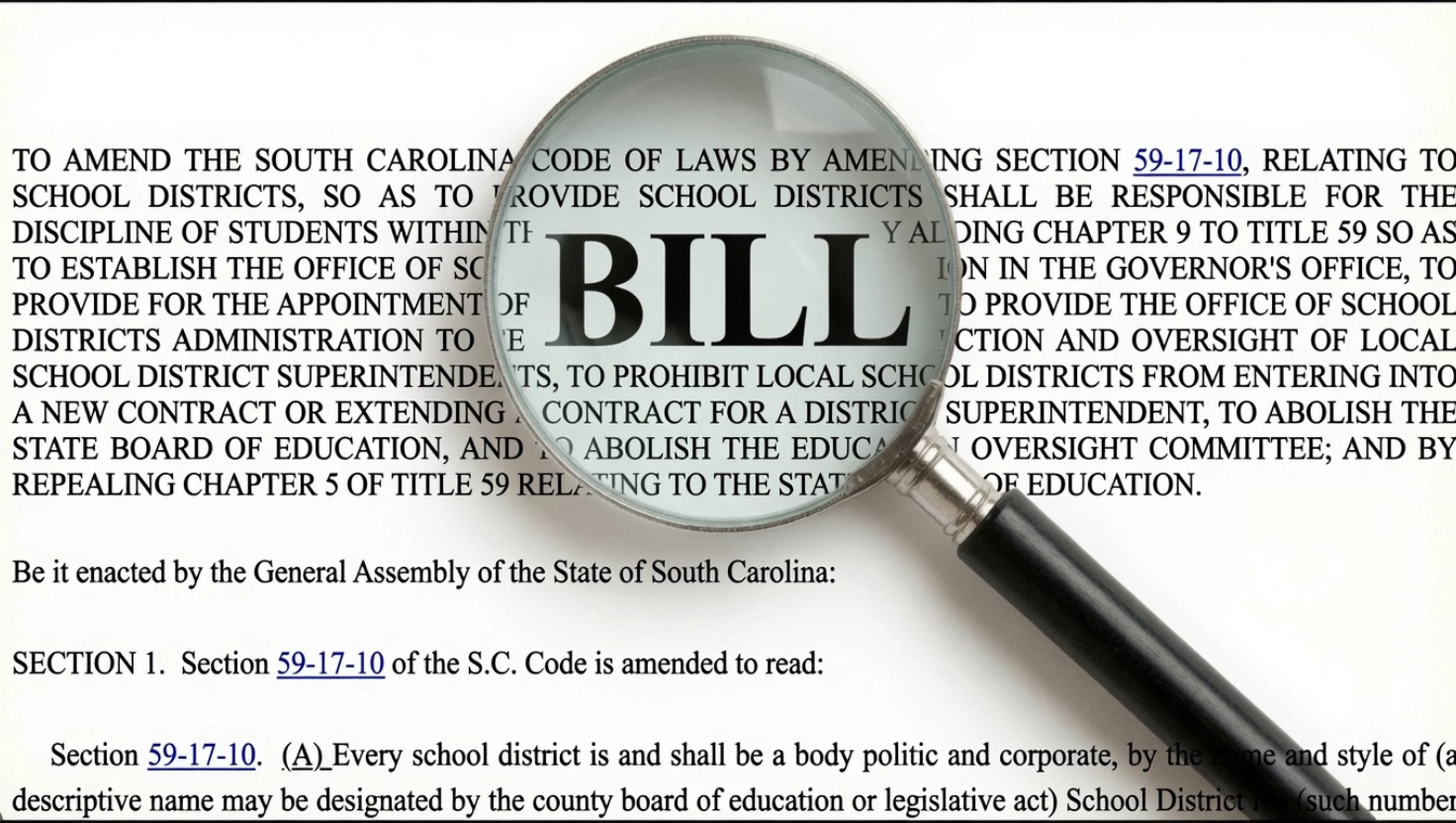
A bill is a draft law. It’s the vehicle legislators use to propose a new law or change an existing one. A bill doesn’t become law until it passes both the House and the Senate and is either signed by the Governor or enacted without a signature, unless it is a constitutional amendment.
The PDF on the South Carolina Legislative Process is a helpful guide for understanding how the process is supposed to work. Use it as a guide, but remember this: there are many more nuances you won’t find documented.
For these lessons, we're focusing on regular bills — the standard vehicle for enacting, amending, or repealing permanent laws in the South Carolina Code. (The General Assembly passes other types too, like resolutions, but those serve narrower purposes, so we'll set them aside for now.)
Go to the South Carolina State House website and search for a bill. When you open the bill’s page, find the most recent version of the bill text. Bills often change as they move through the legislative process, so the bill filed at the beginning may not be the one legislators pass into law.
The Jungle
Opening a bill can feel like walking into a jungle. The growth is thick, you can't see far ahead, and a single careless step drops you into a snare. That's why you don't try to understand the whole thing at once,
Start with the words.
As stated in Tip One for Reading a Bill, the most important pieces of a bill are its WORDS.
Why We Read the Words — From a Concerned Perspective
Bills usually come with nice-sounding titles and positive talking points. But those promises don’t tell the full story. Many bills subtly expand government power, add new spending or taxes, place new restrictions on citizens, or hand authority to unelected officials.
That is why these lessons teach you to read from a concerned perspective. Examine the words carefully because when they become permanent law, they affect your rights, wallet, and liberty.
Look for the words that tell you what the bill is doing to the law.
Most bills do one of three things:
Amend an existing law — examples: '“an act to amend” or “amended to read.”
Add a new law — examples: “creates a new section”, “by adding section”, or “there is established.”
Repeal a law — We love seeing these.
Important to note as you are digging into the words: A bill that changes current law can’t be fully understood by reading it alone. You have to compare it to the current law.
Begin to Mark the Words
Highlight every word you don’t understand.
Underline words that are broad, vague, or unclear. Look for words like reasonable, necessary, appropriate, public interest, safety, welfare, and includes. These words can let an agency, board, court, or official decide later what the law means.
Circle words that create power.
These are the words that give someone the power to act. Every time you see one, ask yourself: Who gets this power, and how much power do they get?
Shall = mandatory. Someone has to do it. No wiggle room.
May = optional. They get to decide whether to act. That decision is the power.
Authorize = gives someone the official green light.
Delegate = passes the power down to an agency or another official.
Look for words that force action or compliance.
These are the words that command people to do something or prohibit them from doing something.
Examples:
Require / Required — Someone must do something
Mandate / Mandated — Stronger version of require
Must — Clear command to act
Prohibit / Prohibited — Something is not allowed
Restrict / Restricted — Limits what someone can do
Cannot / May not — Explicitly forbids action
Forbid — Stronger version of prohibit
Power-grab Words
Pay close attention to these words, as they grant the government more power.
Here are the most common ones:
Notwithstanding — This word overrides other laws. It means this section prevails if it conflicts with other statutes, and it can sidestep limits or protections that previously applied.
Including but not limited to — The list that follows is not complete. It leaves the door open to add more later.
As determined by — This phrase hands the real decision to an unelected agency or official instead of the legislature.
At the discretion of — This phrase gives someone the power to decide how the law will be applied, often with little oversight.
Words That Give the Government Enforcement Power
When you see phrases like “it is unlawful,” “is guilty of,” “is liable for civil penalties,” “may revoke or suspend,” “may withhold funding,” “shall be barred from the program,” “must return funds,” or “may refer to law enforcement,” that’s the bill giving government real enforcement power—fines, loss of rights, loss of money, or even jail.
Don’t Skip the Definitions
Many bills include a section for definitions. When you see a phrase like “As used in this section” or “For purposes of this chapter,” pause. The bill is about to define its own words, and those definitions shape how the rest of the bill works.
After you finish marking the first page, write this sentence at the top:
This bill appears to change __________ by giving __________ the authority to __________.
If you can’t fill in that sentence, keep reading before you trust what anyone says about the bill.
Lesson Summary
Most people decide whether a bill is good based on surface-level information, a headline, a social media post, or a lobbyist summary. They never read the actual words. That’s how bad laws pass with almost no resistance.
This lesson asks you to do one thing differently. Open the bill. Read the actual words. Mark what you don’t understand. Ask who gains power and how far that power reaches.
Read before you support.
Disclaimer: The views expressed in this article are those of the author and do not constitute legal or professional advice. ConservaTruth assumes no liability for any actions taken based on this content. Read more.

Subscribe to ConservaTruth's Email Newsletter for curated insights on South Carolina's legislative activities and conservative viewpoints, delivered straight to your inbox! With vetted and easy-to-understand information, our newsletter empowers you to become an informed and engaged citizen, actively participating in safeguarding our cherished Constitutional values. Don’t miss out on crucial updates—join our community of informed conservatives today!

Comments