
It is time to talk about the “School Choice” trap again.
There is a fundamental piece of advice worth repeating every single day. What government funds, it runs poorly.
Let’s take a step back, but not too far. Less than a year ago, our General Assembly passed S.62 into law. We have written plenty about that bill, which codified a new entitlement program, the Education Scholarship Trust Fund (ESTF). Legislators sold this program as “educational freedom for all,” but it’s more like private choices on a government leash.
S.62 created the framework for government-controlled school choice. Now, as the inevitable pattern of regulatory creep emerges, we have S.692.
We hate being right. We did not expect the squeeze to show up this fast, yet here it is. S.692 arrived with the Senate’s December 10, 2025, pre-filed batch of 69 bills.
What S.692 proposes appears simple. It looks like a few tweaks here and there. Nothing to worry about. It is a “cleanup bill,” which usually means an easy path to passage.
But S.692 is a sleeper bill. Sleeper bills tend to pass easily, but once they do, they cause real damage.
What exactly is S.692 proposing to “clean up” in the ESTF law?
1. Increasing State Control
Section 59-8-110(14)(n) and (i)
S.692 does two things in the qualifying expense list. It tightens subsection (i) by tying supplemental classes to an eligible school and department approval. It also signals removal of the catch-all subsection (n), the line that allowed the department approve almost any “personalized learning” expense consistent with the act’s intent.
It then replaces it with new language in subsection (i) regarding “contracted teaching services and education classes designed to supplement a student’s learning program provided by an eligible school and approved by the department.”
Supplemental classes will be tethered to an “eligible school,” and the department must approve the specific class.
2. State-Approved Home-Based Learning
Section 59-8-115(D)(e)
The proposed change in Section 59-8-115(D)(e) is interesting because it undercuts a claim made by supporters of the ESTF. Legislators, lobbying groups, and policy organizations repeatedly told citizens that homeschoolers were not eligible for ESTF funds.
That claim was never true in practice. S.62 created a loophole, and we flagged it immediately. A family could apply for ESTF funds while still operating under home instruction Option 1, 2, or 3.
How? The parent signs the annual ESTF agreement, which includes self-certification tied to those home instruction statutes. Once the state approves the application, the family continues educating at home using ESTF funds.
The only real change is that the child is no longer operating under Option 1, 2, or 3.
If homeschooling with ESTF funds were truly impossible under current law, there would be no reason to add this language requiring state approval for home-based personalized learning programs.
“(e) …or other home-based personalized learning program not specifically approved by the State Board of Education as provided in Section 59-65-10;”
We need to pause here and speak directly to the homeschool families who signed up for this money.
By accepting these funds, you must comply with all current and future regulations attached to the ESTF. What happens when “approved” means aligning with the exact state standards you left the system to avoid?
3. Removing the Safe Harbor
Section 59-8-115(H)
S.692 strikes the sentence in Section 59-8-115(H) that treats a parent’s ESTF agreement as compliance with compulsory attendance.
Once removed, the signed agreement no longer functions as an explicit statutory safe harbor. The bill does not specify what replaces it.
The Expensive Handout
These proposed tweaks in S.692 are not harmless tweaks. They represent the kind of tightening seen when a program moves from a pilot-sized experiment into a permanent, fast-growing, expensive line item.
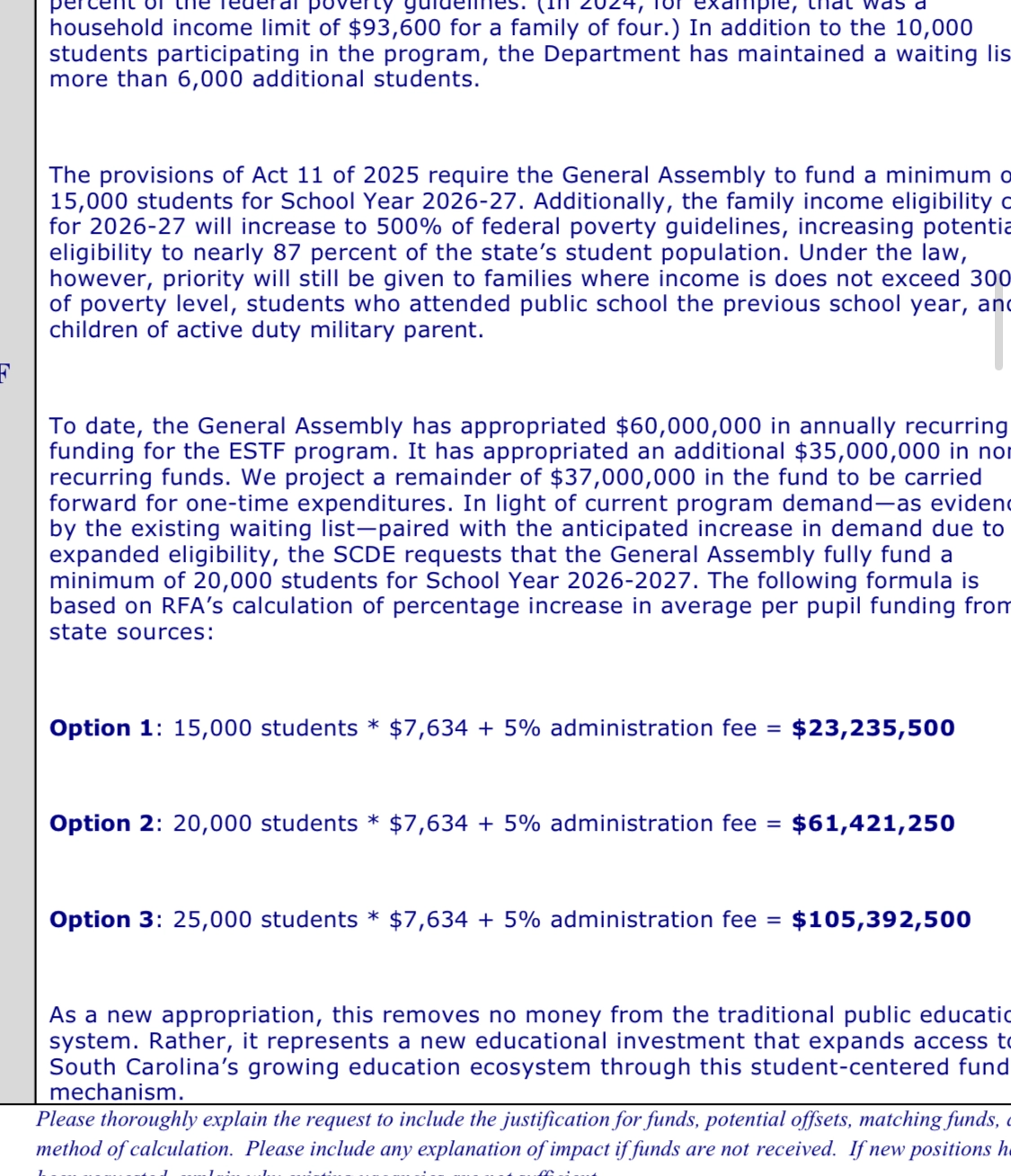
Speaking of expenses, the SC Department of Education is requesting $61,421,250 in new recurring funds for the current budget cycle, FY 2026 to 2027. That request is an add-on, layered on top of funds already appropriated and sitting in the program.
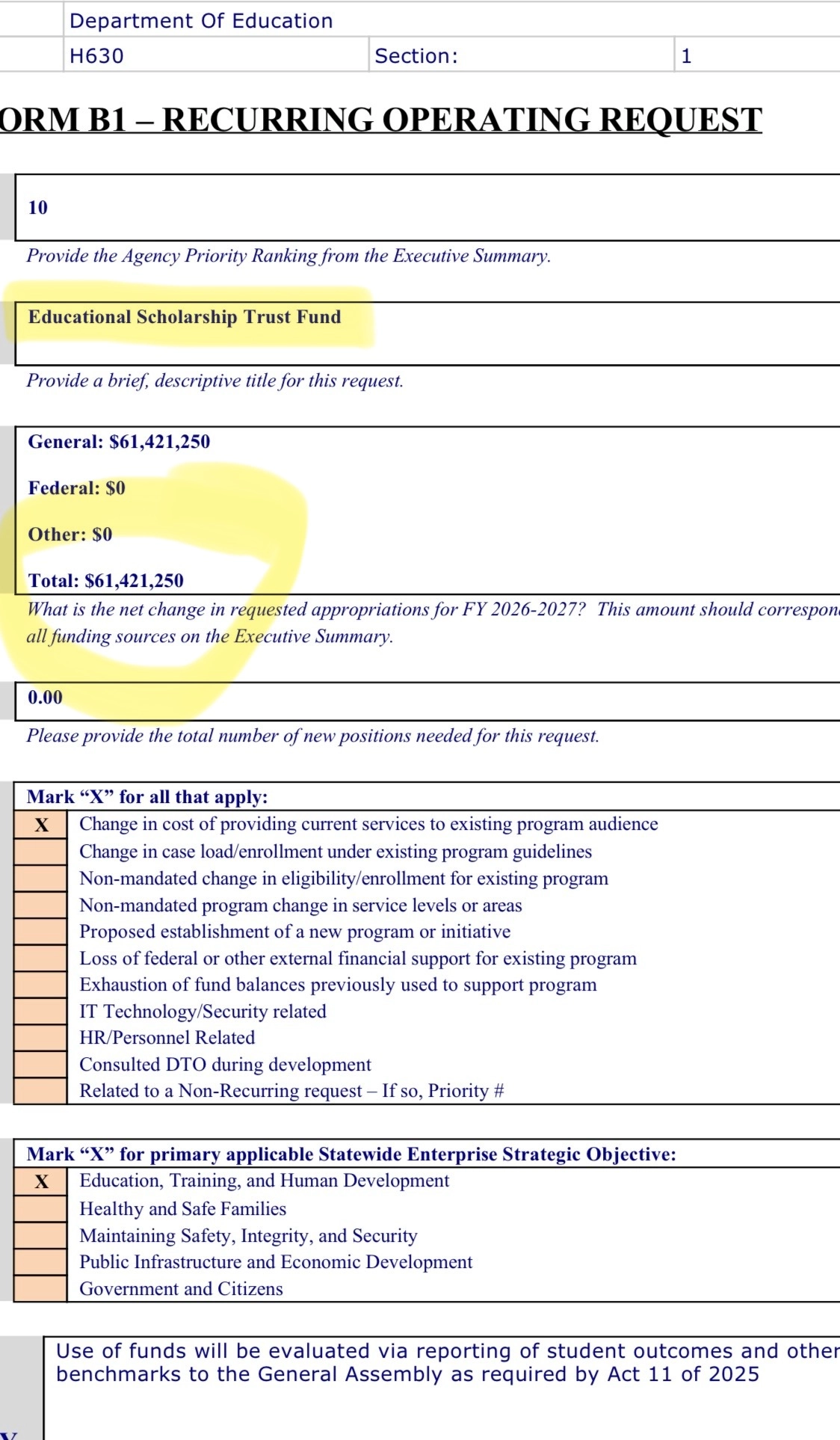
They also want the budget built around at least 20,000 students for 2026 to 2027 as eligibility expands to 500% of the federal poverty guidelines. That trajectory points toward near-universal participation.
South Carolinians, why would you be comfortable with this? The ESTF program’s regulatory scope and expenses are already growing. That growth will accelerate as more families begin depending on the money. Before long, the state will have its hands in every education option, even homeschooling. School choice without government interference will become a thing of the past.
Disclaimer: The views expressed in this article are those of the author and do not constitute legal or professional advice. ConservaTruth assumes no liability for any actions taken based on this content. Read more.

Subscribe to ConservaTruth's Email Newsletter for curated insights on South Carolina's legislative activities and conservative viewpoints, delivered straight to your inbox! With vetted and easy-to-understand information, our newsletter empowers you to become an informed and engaged citizen, actively participating in safeguarding our cherished Constitutional values. Don’t miss out on crucial updates—join our community of informed conservatives today!

Comments