
Welcome to Lesson Two. We hope you had a chance to go through Lesson One and practice with a real bill.
We will continue to provide you with tips to help you read a SC bill, but nothing can replace practice.
Why This Is So Hard in South Carolina
Holding people accountable has been one of the hardest fights grassroots conservatives face here in South Carolina. Reflect on the pandemic era, where the misuse of police authority left citizens without recourse; yet no one was held responsible for those transgressions. Who answered for the mask mandates? The vaccine mandates? Even many legislators struggled to point to exactly who should face consequences.
Why is holding elected officials accountable often so difficult?
Answer: We have TOO MUCH LAW!
Think about it: we deal with an explosion of hyper-detailed statutes, regulations, and procedures that try to micromanage every possible decision. The result is a system where no one can act without navigating a thicket of rules. Officials lose the ability to use judgment for practical outcomes. They just comply and pass the buck.
Every new law creates another layer between the people and the person responsible for the outcome.
Picture how this works.
A bill passes and hands broad power to an agency. The agency writes regulations to carry it out. Those regulations multiply into more rules, procedures, and steps.
When the law fails or violates your rights, good luck figuring out who to hold responsible, because the agency points to the law, the legislators point to the agency, and the people are left chasing both and dealing with the aftermath of bad law stacked on top of too much law.
So, the point of this lesson is to show you how one more bill makes it even harder to hold anyone accountable when its power is abused.
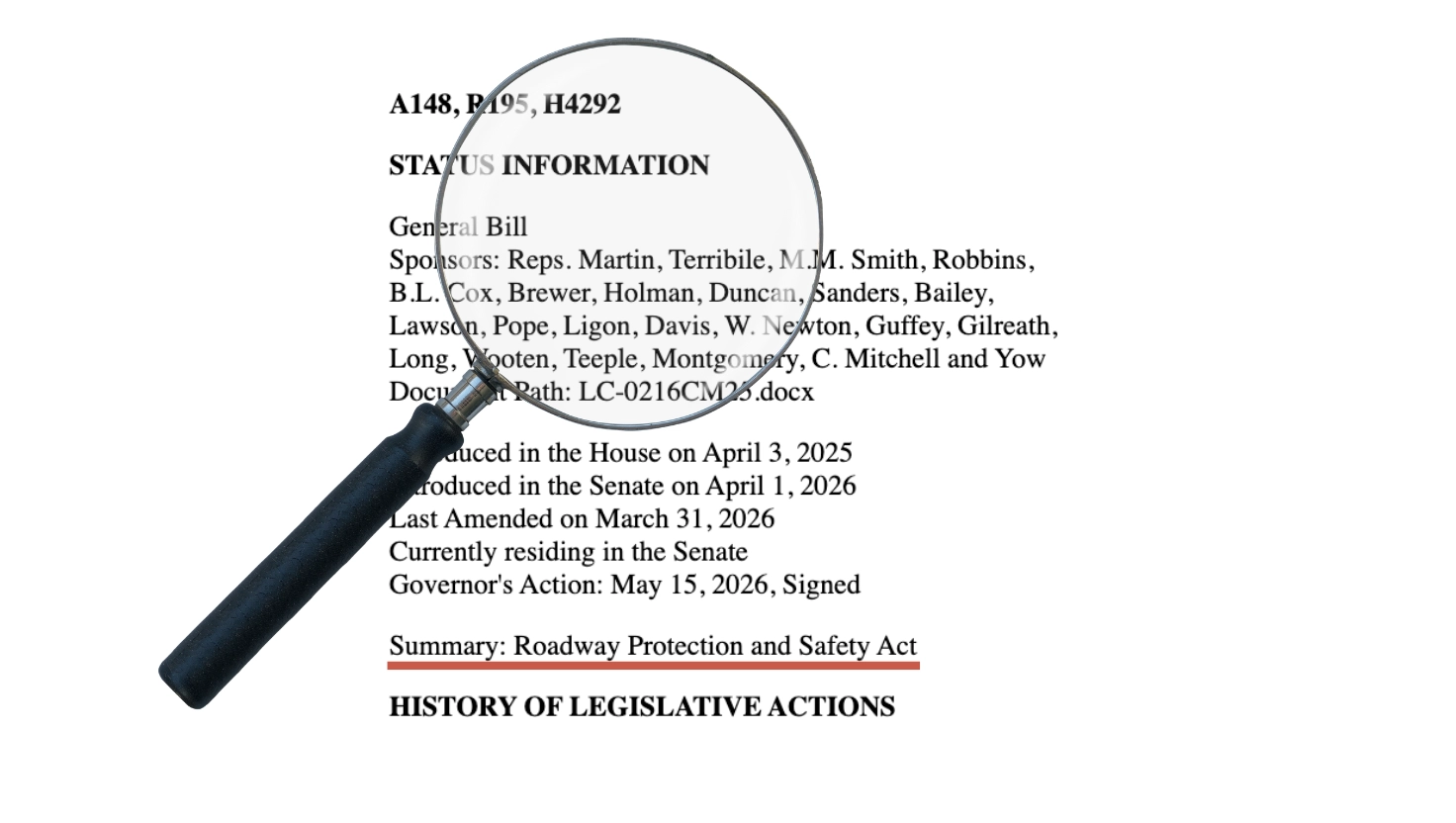
We will use H.4292, the Roadway Protection and Safety Act, as our example. South Carolina already has multiple laws on the books that cover virtually everything this bill claims to address, as we documented in our full analysis. In other words, H.4292 is exactly the kind of "one more law" we just described.
Can You Identify Who Gains Authority?
In Tips for Reading a Bill, you learn about power words. Those words grant authority to act. The accountability problem begins when a bill does not clearly identify who holds that authority. If the bill does not lead you to one identifiable person, then it does not lead you to someone the public can hold accountable.
For instance, look at these phrases. Notice how they don't point to one official the public could hold responsible for abusing it.
"The Director shall..." Does the director make the decision, or does the director follow a board, commission, or regulation?
"The Department shall..." refers to an agency and not a specific person.
"The State shall..." or "It shall be the policy of..." names no one, and it's classic vague language that spreads responsibility so thin it basically disappears.
Using our bill example, H.4292, Section 56-5-3910(F): "Any vehicle used by a participant, organizer, or an aider and abettor during a street takeover, shall be seized by the responding law enforcement agency..."
Problem: It says "the law enforcement agency" — not a specific officer, not a director, not even a named department with a clear chain of command. When something goes wrong (wrongful seizure, abuse of discretion, targeting the wrong people), you cannot point to a single identifiable person whom voters can hold accountable.
Words That Spread the Blame
Look for words and structures that scatter responsibility all over the place.
For instance, words like these:
Board, commission, or committee. You face nine people who voted 5 to 4. Which one do you hold accountable?
In consultation with. The director says the council recommended it. The council says the director decided. Each blames the other.
Subject to the approval of. One office acted; another approved. So who is to blame?
As determined by or at the discretion of. The official decides with no standard to guide the decision.
Consistent with federal law. Your state official blames the federal government.
In H.4292, Section 56-5-3910(F), "Upon request, the seized vehicle may be returned to the owner or lienholder of the vehicle at the discretion of the responding law enforcement agency."
Problem: "At the discretion" is extremely broad. If the responding officer oversteps, there's no mechanism in this bill to hold the agency accountable for that overstep.
Test the Sentence on H.4292
If this power is abused and my rights are trampled, __________ is responsible, and can be held accountable by __________.
Try filling it in using only the bill's text.
We walked through every one of these problems in detail in our full analysis, H.4292: Roadway Protection or Rights Erosion?
Lesson Summary
Bills blur the line of accountability, and the people pay for it. So when you read a bill, read it twice. On the first pass, look for who gains authority. On the second, ask who will be held accountable when that authority is abused. Then fill in the test sentence, and if the second blank stays empty, you've found a major red flag.
Disclaimer: The views expressed in this article are those of the author and do not constitute legal or professional advice. ConservaTruth assumes no liability for any actions taken based on this content. Read more.

Subscribe to ConservaTruth's Email Newsletter for curated insights on South Carolina's legislative activities and conservative viewpoints, delivered straight to your inbox! With vetted and easy-to-understand information, our newsletter empowers you to become an informed and engaged citizen, actively participating in safeguarding our cherished Constitutional values. Don’t miss out on crucial updates—join our community of informed conservatives today!

Comments