

Right now, you’re probably juggling the inflated expense of groceries, medical, gas, insurance, rent, power bills, car repairs, and property taxes. And into that reality strolls S. 933, a bill that would raise legislators’ pay to $47,500 a year, with built-in inflation adjustments every two years.
There is something strange about legislators on a mission to increase their own pay.
How much more is this going to cost us?
Let’s take a look at the fiscal impact statement. It states that this increase would cost taxpayers an additional $4,267,000 each year. Read that again, an additional $4.27 million per year. That comes from raising each member’s total compensation by $25,100 across 170 members of the General Assembly. The breakdown given is $3,112,400 for the House and $1,154,600 for the Senate. The proposal would more than double South Carolina lawmakers’ current $22,400 compensation and put them well above the average pay for part-time state legislators.
But, wait, there is more.
This raise also makes the legislators' retirement system more expensive. The fiscal impact states it adds about $11 million in pension liability if paid over time, or about $34 million if paid up front. Under the slower payment option, the legislators’ retirement system drops from 84.1 percent funded to 57.8 percent funded.
So the real price tag is about $4.27 million more every year in direct pay, plus about $11 million more in retirement liability if the state spreads that pension cost out over time, or about $34 million if it covers the full pension hit immediately.
This is indeed a sleeper bill that comes with a hefty price tag.
But the legislators deserve a raise. After all, legislating is hard work and costly. Higher pay could help ensure that talented and qualified people from all walks of life can afford to serve without significant financial sacrifice, rather than only those who are independently wealthy or retired.
Ok, that is fair, but the pushback is to ask why our legislators keep making the job bigger than it needs to be.
Why do they file thousands of bills every session?
Why do they waste so much time during legislative sessions on ceremonial fluff, faction shout-outs, birthday speeches, self-congratulations, and other time-fillers that burn through session days on the taxpayer’s dime?
Why are we pretending the fix for legislative overload is to throw more money at it, when the real answer is to stop overloading in the first place?
If the workload is too much, here’s a thought: shorten the session and file fewer bills. Stop turning every session into a mashup of policy and performance art. Handle the essentials. Then go home.
That’s a lot closer to what South Carolina actually needs.
Another claim is that a pay raise will make it easier for Fred or Ethel to run for office and somehow reduce the grip of factions, lobbyists, and special interests. That seems hopeful, although it is an illusion. More money does not stop corruption or strengthen character. It does not make a legislator any harder to influence.
The last thing South Carolina needs is the idea that legislating should be a full-time job. That’s how you end up with what we currently have: a class of career politicians who think they earn a raise for legislating our freedoms away.
A part-time, citizen-run legislature is supposed to have built-in constraints. Those limits help slow the urge to pass bad laws simply because they can. They also help keep government from expanding as its own reward, which is exactly what S. 933 represents.
South Carolinians are already shouldering the burden of bad policy, which has added to rising costs and a government that never seems to get any smaller. The last thing our legislators need is a reward for bad behavior.
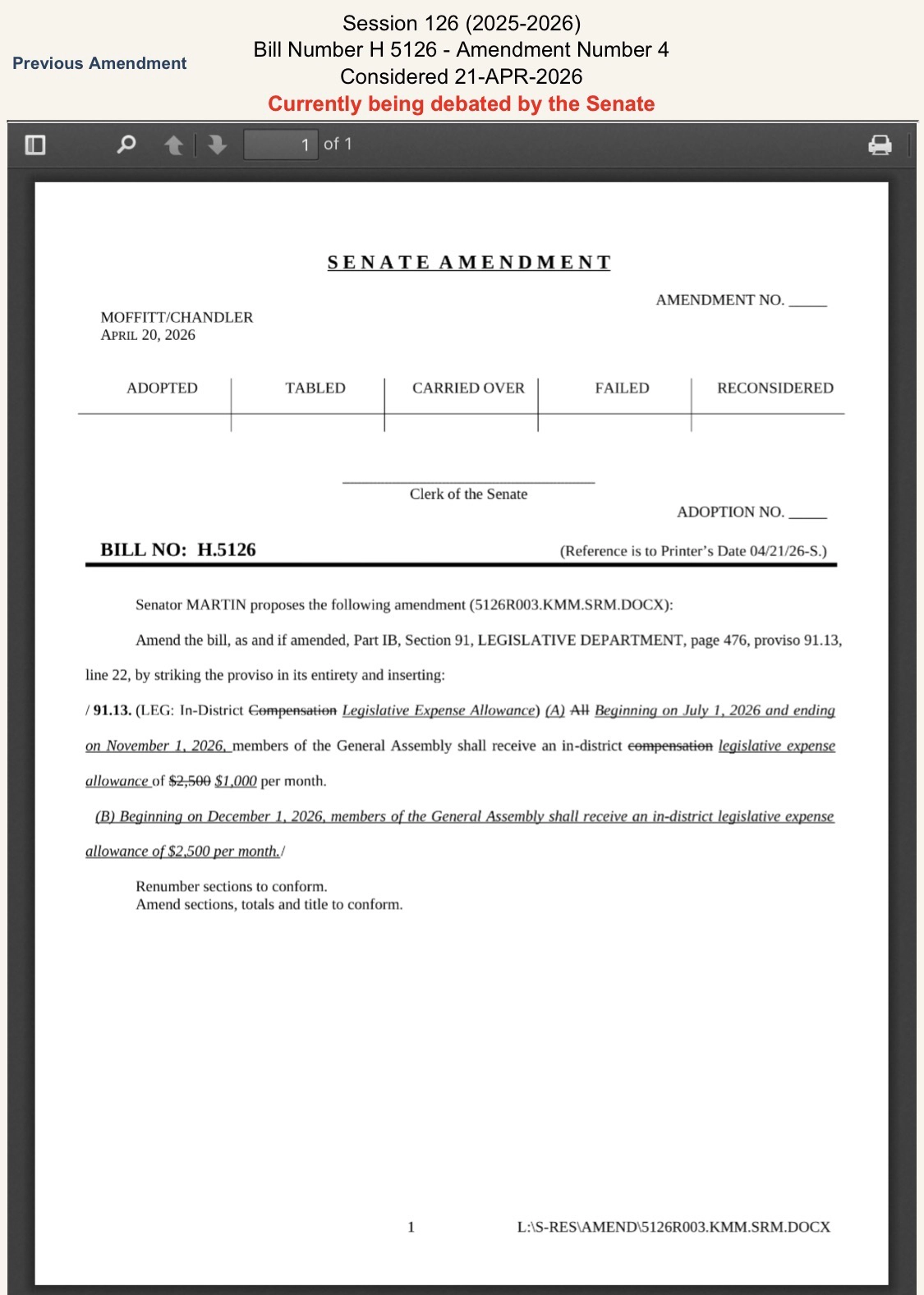
Call to action: S.933 is on the Senate calendar, and the Senators will discuss it on the floor. Contact your Senator and ask them to vote no and to also remove Senate Amendment 4 from SC House Bill H.5126, which changes the term from “In-District Compensation" to "Legislative Expense Allowance” and increases the allowance to $2,500 per month going forward.
The most effective way to make your voice heard is to call or email your Senator’s office directly. You can find your Senator’s contact information on scstatehouse.gov. Short, personal messages get noticed. If you prefer, you can also visit your Senator’s office in person or attend town hall meetings. Be clear and specific about your opposition when you reach out.
Remember what our founder Madison stated: legislators were called, for the most part, from pursuits of a private nature, served for a short time, and operated within a Constitution that built in checks to slow the excess of lawmaking.
Disclaimer: The views expressed in this article are those of the author and do not constitute legal or professional advice. ConservaTruth assumes no liability for any actions taken based on this content. Readers are encouraged to review the bill text themselves. Read more.

Subscribe to ConservaTruth's Email Newsletter for curated insights on South Carolina's legislative activities and conservative viewpoints, delivered straight to your inbox! With vetted and easy-to-understand information, our newsletter empowers you to become an informed and engaged citizen, actively participating in safeguarding our cherished Constitutional values. Don’t miss out on crucial updates—join our community of informed conservatives today!

Comments